One control plane from the GPU up to the token, with governance and conversational
operations across every layer.
The platform
Full-Stack AI Operations, from Silicon to Token
UPC VEKTOR orchestrates GPU infrastructure, fabric, workloads, tenants, and token consumption through a unified operational layer built for scalable AI services.
One console for the whole AI factory
Spot idle capacity, approve the fix, and watch utilization and cost-to-serve improve, without leaving UPC Vektor.
Higher GPU utilization
Find idle GPUs across racks and put them back to work on the workloads that need them.
Lower cost-to -serve
See the cost per million tokens drop as capacity moves to where demand is.
Human-approved automation
Vektor proposes the change, your team approves it, and the runbook does the rest.
One view of everything
Fleet, token economics, tenants, and ChatOps side by side in a single console.
Optimize your GPU fleet at scale
Provision and monitor clusters, map rack and network topology, track thermal and power utilization, and manage capacity across GPU pools based on workload demand.
Cluster provisioning
Stand up and monitor GPU clusters from one place.
Topology mapping
See rack and network topology, down to the top-of-rack switch and spine fabric.
Thermal and power tracking
Catch hotspots early and track power draw and PUE across the fleet.
Demand-based capacity
Rebalance training, inference, and free pools as workload demand shifts.
Optimize token economics in real time
Track token throughput, latency, and cost by model, tenant, and workload, and compare private inference economics with public APIs to make smarter placement decisions.
Live inference metrics
Throughput, p95 latency, and cost per million tokens for every model and tenant.
Private vs public comparison
Compare what each workload costs on your GPUs against public APIs.
Smarter placement
Get recommendations on where each workload runs most cost-effectively.
True cost per token
Placement factors in GPU power, PUE, and interconnect economics.
Operate a multi-tenant AI service layer
Manage tenant onboarding, GPU allocation, API access, RBAC, and usage metering from a unified control plane, with placement aligned to SLA, cost, and available capacity.
Fast tenant onboarding
Add a tenant, allocate GPUs, issue API keys, and assign roles in one flow.
Access control
Per-tenant API access with role-based permissions for service management.
Usage metering
Meter token consumption and workload cost by tenant for chargeback and showback.
SLA-aware placement
Workloads land where SLA, cost, and available capacity line up.
Orchestrate LLMs across runtimes and clouds
Abstract inference across vLLM, LiteLLM, TensorRT-LLM, and public APIs, and port workloads between private and public environments.
One endpoint
An OpenAI-compatible API router deployed in front of every runtime.
Multiple runtimes
Serve with vLLM, LiteLLM, TensorRT-LLM, or public APIs.
No vendor lock-in
Move workloads between cloud environments without application changes.
Framework support
Works with PyTorch, TensorFlow, ONNX, and CUDA.
Govern AI operations with control and compliance
Enforce RBAC, SSO, MFA, and per-tenant policies, centralize audit logs and compliance visibility, and secure workloads with hardware-backed confidential computing.
Identity and access
RBAC, SSO, and MFA enforced on every request for secure access control.
Per-tenant policy
Per-tenant policies prevent cross-tenant access, ensuring complete isolation of data
Central audit trail
Every allowed and denied action is logged in one place for compliance.
Confidential computing
Hardware-backed protection keeps workloads encrypted while in use.
Manage the factory through ChatOps
Monitor fleet health, identify idle GPUs and performance issues, and execute runbooks, deployments, and rollbacks through conversational operations with human approval.
Natural Language Interface
Check fleet health or identify idle GPUs instantly using natural language queries.
Detect Issues Faster
Surface idle capacity and performance problems before users notice.
Runbooks on Demand
Run deployments, reassignments, and rollbacks from the conversation.
Human in the Loop
Nothing changes until someone on your team approves it.
Sovereignty & private inference
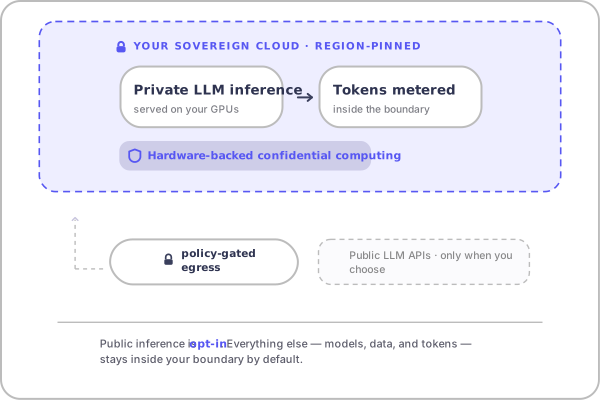
Private AI Inference, Within Your Boundary
Keep models, data, and inference workloads under your control while meeting residency and regulatory requirements and optimizing the economics of every inference.
Run LLMs on private GPUs
Control data residency and compliance
Protect workloads with confidential computing
Compare private and public inference costs
Why UPC VEKTOR
Turn AI Infrastructure into Measurable ROI
Optimize GPU utilization, power, cooling, and workload placement while gaining control over token economics, isolation, and portability across private and public inference environments.
01
Maximize Fleet Utilization
Optimize workload placement using real-time cost per million tokens, factoring in GPU power and PUE.
02
Make AI Revenue Measurable
Meter token consumption and workload costs by tenant to support transparent pricing.
03
Keep Workloads Portable
Orchestrate across private and public LLM environments without vendor lock-in, as models evolve.
04
Scale Without Losing Control
Enforce tenant-level policies, and protect workloads with confidential computing.
05
Accelerate Production
Move from factory design to operational handover through a structured path built for deployment.
Delivery model
From Infrastructure to Production-Ready AI
UPC VEKTOR structures AI factory operations across four delivery stages, from infrastructure design to operational handover, giving clients a production-ready factory with full autonomy post-delivery.
01
Design
Plan GPU topology, tenant architecture, network fabric, service catalog, capacity, and token pricing.
02
Build
Deploy the stack, onboard tenants, activate workloads, connect LLM APIs, and validate token flows.
03
Operate
Monitor GPU health and token throughput, optimize workloads, manage costs, and enforce governance.
04
Monetize
Meter tenant usage, automate chargeback and showback, and measure revenue against cost-to-serve.
Turn GPU Capacity into AI Revenue
Experience global scalability and unmatched reliability through our hyperscaler partnerships.