The future is hybrid
Power, performance and software-defined scale.
Hybrid Colocation as a Service puts your servers in UnitedLayer data centers and connects them to United Private Cloud® and the public clouds. You get low latency, high availability and strong security, with resources you can scale on demand instead of buying up front. And it comes with UnityOne AI™, our AI platform that monitors, automates and optimizes the whole footprint.

Availability

0 %

UnitedLayer data centers in the US West

0

Security monitoring and incident response

/7

AI-run

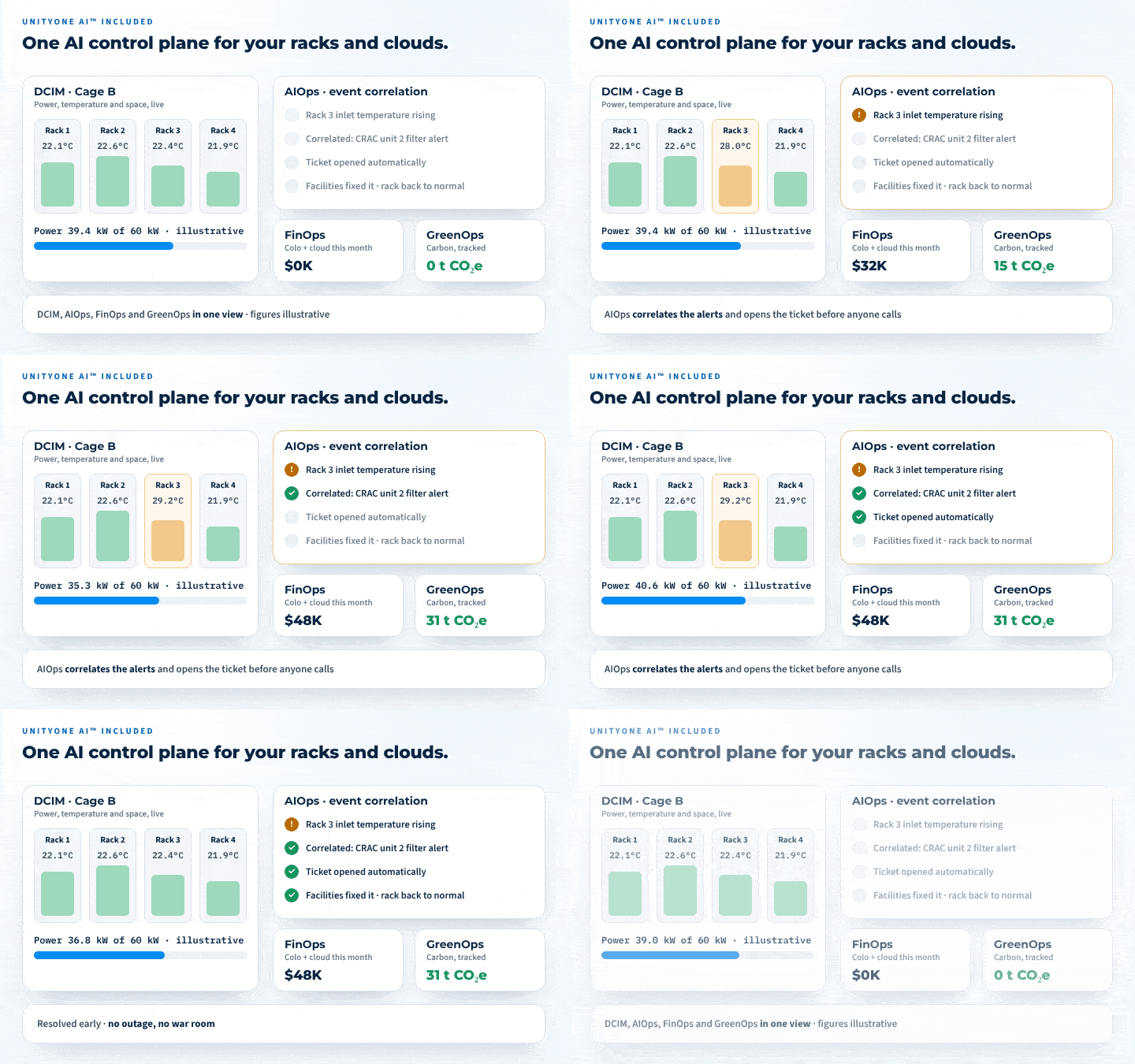
UnityOne AI™ included: DCIM, AIOps, FinOps, GreenOps

colo.unitedlayer / example-bank
FOOTPRINT
SERVICE
UNITYONE AI™

San Francisco footprint

Example tenant · colocation + private cloud + public cloud
Racks4
Cloud links1
Cloud burst64 vCPU
Open work orders1
Item · detailStatus
Included
Low-latency, high-performance hybrid colo as a service

Colocation that works
like part of your cloud

Cost efficiency, high performance, enhanced security and scalability, with as much of the
running done for you as you want.
Included with hybrid colocation

UnityOne AI™ runs
alongside your racks

Most colocation stops at space, power and a ticket portal. Ours comes with UnityOne AI™, one AI
control plane across your cage, United Private Cloud® and the public clouds, so you see, fix and
optimize everything in one place.
300+Customers on UnityOne AI™
50%Faster ticket resolution in a customer case study
30%Lower CO₂ in a customer’s global IT estate
Private LLMsGenAI insights that keep your data in-house
See it in motion

Watch hybrid colocation at work

Seven moments from a hybrid footprint, from UnityOne AI™ catching a warm rack to a disaster
recovery drill.
UnityOne AI™ comes with it. DCIM spots a warm rack, AIOps correlates the alerts and opens the ticket, and cost and carbon stay in view. Figures illustrative. A direct line to every cloud. Your racks reach AWS, Azure and Google Cloud over UnitedConnect® instead of the public internet. Peaks go to the cloud next door. Steady load runs on your colocated servers, and peaks burst into United Private Cloud® without new hardware. Illustrative. Remote hands do the physical work. Fiber, rack, cabling, servers and network devices installed and brought online by our engineers. Manage as much as you like. Hand over physical, network, systems, security and protection layers one by one, or all at once. Only the right people get in. Badge, multi-factor authentication and an access list, under 24/7 CCTV, aligned with HIPAA, PCI DSS and GDPR. Recovery in another data center. Production in San Francisco replicates to Las Vegas, and a DR drill proves services can run from there.
LIVE · AUTO-PLAYING
Locations

Three data centers
on one network

Place production, recovery and edge workloads where they fit best, linked to each other and to
your clouds through UnitedConnect®.
UnitedLayer data center
San Francisco

200 Paul Ave, San Francisco, CA

Production hub for colocation and United Private Cloud®, with direct cloud interconnects.

UnitedLayer data center

Los Angeles
624 S Grand Ave, Los Angeles, CA
Southern California presence for colocation, connectivity and edge workloads.

UnitedLayer data center

Las Vegas
7135 S Decatur Blvd, Las Vegas, NV
A recovery site away from coastal risk, used for disaster recovery from San Francisco.
Plan your footprint

What would your hybrid
footprint look like?

Tell us what you run and how spiky it is, and see a starting point for racks, private cloud burst
capacity, cloud links and who does what.
60
40%
32
Clouds to connect
How much should we run?
4Racks to start
2,304Burst vCPU on United Private Cloud®
4Redundant cloud links
Who does what

Planning sketch with simple rules of thumb: about 16 servers per rack with room to grow, peak capacity on United Private Cloud® at 3 vCPU per physical core, and two diverse links per cloud. Your UnitedLayer architect confirms space, power and connectivity from an assessment.

How it works

From your data center
to hybrid in five steps

Why hybrid colocation

Scalable, integrated,
efficient and secure

Seamless hybrid integration

Colocation, private cloud and public cloud as one infrastructure.

Low-latency connectivity

Fast links between colocation facilities and cloud platforms.

On-demand resources

Scale up or down without significant capital expenditure.

Customizable solutions

Colocation and cloud configured for your workloads.

Lower total cost

Colocation and cloud combined, with flexible pricing models.

Advanced security

24/7 surveillance, multi-factor authentication and controlled access.

Compliance

Aligned with HIPAA, PCI DSS and
GDPR.

Legacy compatible

Keep the systems that still matter, next to modern cloud.

24/7 support

Technical support around the
clock.
Customer stories

What teams have
built with UnitedLayer

Banking · Oracle

15-min RPO · 1-hour RTO
Production in San Francisco, recovery in Las Vegas, DR drills twice a year and annual security audits.

Oil and gas

Zero RPO · 30% lower cost
Private cloud with redundant AWS connectivity across three US data centers and a VMware stretched cluster.

Media

CapEx-heavy hardware retired
Caged racks, biometric access, peer-to-peer cross-connects and customized VMware hypervisors, with UnityOne AI™ for unified management and monitoring.

Energy utility

One view of a distributed estate
Asset discovery, cost analysis and carbon footprint across hybrid, multi-cloud and edge.
Side by side

Three ways to house
your infrastructure

AreaYour own data centerTraditional colocationHybrid Colocation as a Service
Up-front costBuilding, power and coolingLower, then hardware for every peakLower CapEx, with peaks on private cloud
Cloud connectionsCircuits you arrangeUsually your problemDirect links to AWS, Azure and Google Cloud via UnitedConnect®
ScalingBuild or buy moreBuy more hardware, wait for itOn demand, into United Private Cloud®
Hands-on workAll yoursSpace and power onlyRacks, cabling, network, systems and security, managed if you want
SecurityYours to staffPhysical onlyPhysical controls plus Security as a Service
RecoveryA second site to buildA second contract to set upDRaaS and a second UnitedLayer data center
Operations platformTools you buy and integrateA ticket portalUnityOne AI™ included: DCIM, AIOps, FinOps and GreenOps
SupportYour team, all hoursBusiness hours or tickets24/7 technical support
Questions

What teams ask before they start

What is hybrid colocation as a service?

Your servers live in a UnitedLayer data center and connect directly to United Private Cloud® and to public clouds. You can scale into the cloud on demand and choose how much of the running UnitedLayer does for you.

Which clouds can our colocated servers connect to?

AWS, Microsoft Azure and Google Cloud, through direct UnitedConnect® links rather than the public internet, which reduces network cost and increases bandwidth.

Does it work with United Private Cloud®?

Yes. Colocation integrates with United Private Cloud® for x86 systems running VMware or Hyper-V, so you can run steady workloads in your racks and burst or migrate into the private cloud.

What can UnitedLayer manage for us?

Physical work such as fiber circuits, rack installation, cabling and wiring; network devices such as firewalls, load balancers and switches; operating systems and hypervisors; and security, with DRaaS, private cloud and data protection services alongside.

How are our racks secured?

With 24/7 surveillance, multi-factor authentication and controlled access. The service is aligned with HIPAA, PCI DSS and GDPR, and Security as a Service covers threat identification, response and mitigation.

What does UnityOne AI™ add to our colocation?

UnityOne AI™ is UnitedLayer’s AI platform for hybrid and multicloud operations, included with hybrid colocation. DCIM shows power, temperature and space in your cage; AIOps reduces noise, correlates events and automates resolution; FinOps tracks colocation and cloud spend together; GreenOps measures your carbon footprint; and a GenAI co-pilot on private LLMs answers questions about your estate.

Can we keep our legacy systems?

Yes. Hybrid colocation supports footprints that mix data centers, private clouds and public clouds, so legacy systems can stay while the rest modernizes.

↑