

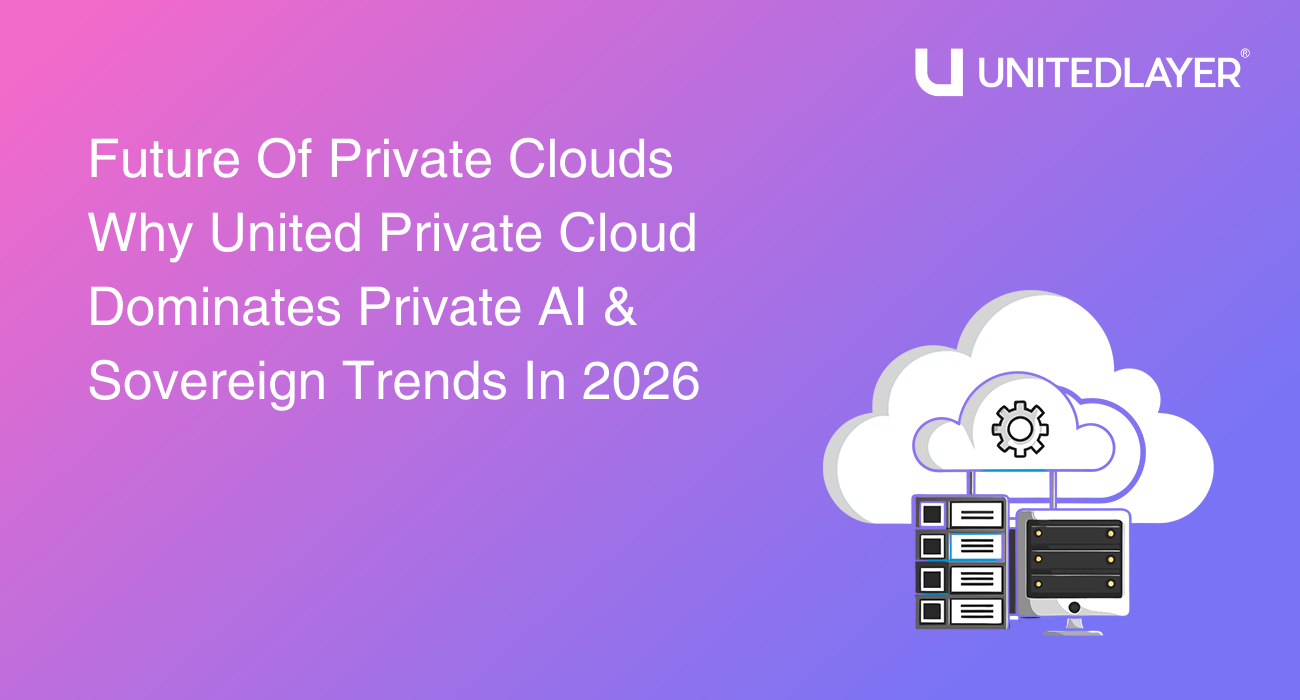
By 2026, private clouds are no longer a fallback — they’re the enterprise standard. The market is undergoing a structural shift driven by Private Cloud 2026 trends: hyperscaler instability, escalating sovereignty mandates, and the operational demands of AI workloads.
Global enterprises are refocusing on control, predictability, and compliance. As public cloud outages expose systemic fragility, business leaders are redistributing workloads to private, sovereign environments that deliver assured uptime and regulatory confidence.
In this realignment, UnitedLayer’s United Private Cloud (UPC) has become the preferred enterprise platform for AI infrastructure resilience, data sovereignty, and cost-optimized performance — delivering what hyperscalers can’t: isolation, continuity, and compliance at scale.
Unlike providers still prototyping sovereign architectures, UPC private cloud already delivers production-grade outcomes. Its N+M architecture sustains 99.999% uptime, while GPU-optimized clusters enable AI training 40% faster than comparable multi-tenant platforms.
UPC’s model is rooted in single-tenant isolation, ensuring deterministic performance, complete compliance control, and predictable cost structures — all without sacrificing the elasticity enterprises expect from modern cloud systems.
This balance between sovereignty and agility defines why UPC leads in the enterprise cloud transformation now accelerating globally.
Private AI 2026 is redefining how industries approach data and compute. Regulated sectors such as finance, healthcare, and telecommunications are migrating their AI and analytics workloads to dedicated private clouds to mitigate risk and maintain governance control.
Meanwhile, sovereign cloud trends are reshaping compliance models across jurisdictions. The EU’s Digital Sovereignty Act and emerging U.S. federal data localization policies are making geo-fenced private environments a business necessity, not an option.
At the same time, recurring hyperscaler outages are forcing CIOs to revisit dependency risk. Industry analysts expect 15–20% of enterprise workloads to be re-shored to private environments by 2026, primarily for operational independence and SLA assurance.
Finally, as edge and hybrid workloads scale, enterprises need unified orchestration between data centers, edge devices, and sovereign zones. UPC’s architecture enables this integration seamlessly — maintaining latency control while delivering sustainability and up to 40% lower operational costs.
UPC’s value proposition goes beyond infrastructure. It operationalizes AI-driven automation and security within the private domain — giving enterprises a self-managing, self-healing environment.
Its predictive auto-scaling engine provisions GPUs and CPU resources in real time based on workload analytics, optimizing compute efficiency while minimizing waste. AI-powered anomaly detection continuously scans the N+M infrastructure layer, reducing breach exposure by a factor of five versus conventional monitoring tools.
UPC’s self-healing orchestration enables autonomous recovery within 30 seconds, allowing continuous uptime across AI training and production environments.
The platform also features federated learning capabilities, enabling multi-site AI model training without data movement — essential for compliance under sovereign cloud mandates. And with predictive cost optimization, enterprises achieve up to 50% TCO reduction without compromising uptime or compliance.
The result: a fully intelligent private cloud that combines AI efficiency, regulatory assurance, and operational resilience into one unified system.
According to IDC forecasts, 60% of enterprises will operate within private or hybrid models by 2026. This migration is not about preference — it’s about survival. The demand for AI infrastructure resilience and sovereign cloud assurance is now embedded in board-level risk strategy.
UPC’s track record is quantifiable. It supports over 100 enterprise deployments globally, delivers $500M+ in realized savings, and upholds five-nines availability across mission-critical environments. Its alignment with compliance frameworks (GDPR, FedRAMP, HIPAA) further cements its leadership in enterprise-grade private AI infrastructure.
Clients consistently report 5x ROI driven by faster time-to-deployment, reduced outage exposure, and optimized resource utilization.
In an era of “cloud chaos,” UPC private cloud offers predictable economics, deterministic performance, and strategic sovereignty — attributes now defining the next chapter of enterprise infrastructure.
The narrative has shifted: Private Cloud 2026 trends aren’t a reaction; they’re the new enterprise mandate. Organizations are moving decisively toward infrastructure that they own, control, and trust.
UPC embodies that future today — delivering a secure, sovereign, AI-optimized cloud that meets the operational and regulatory demands of tomorrow’s enterprises. It enables CIOs to execute AI strategies with confidence, compliance, and cost control, while freeing them from the volatility of public dependencies.
As the global cloud market redefines itself around trust and autonomy, United Private Cloud stands as the reference model for what “enterprise-ready” truly means.
Enterprises preparing for the 2026 inflection are partnering with UnitedLayer. Connect with us today for a complimentary infrastructure audit, AI-readiness assessment, and access to sovereign AI deployment support.

Mansi is a Content Strategist at UnitedLayer, specializing in product marketing. She demonstrates writing fluency across cloud computing, AI, and emerging technology. Her work operates at the intersection of technical depth, structured thinking, and narrative clarity, grounded in deep product, trend, and scope research.




Mansi singh