

In the rapidly evolving landscape of 2026, Artificial Intelligence has moved beyond being a simple digital assistant. It is now the primary engine of global industry. Companies use complex neural networks for genomic sequencing. Others rely on real-time predictive analytics to manage global supply chains. Because of this, the demand for high-performance compute is relentless.
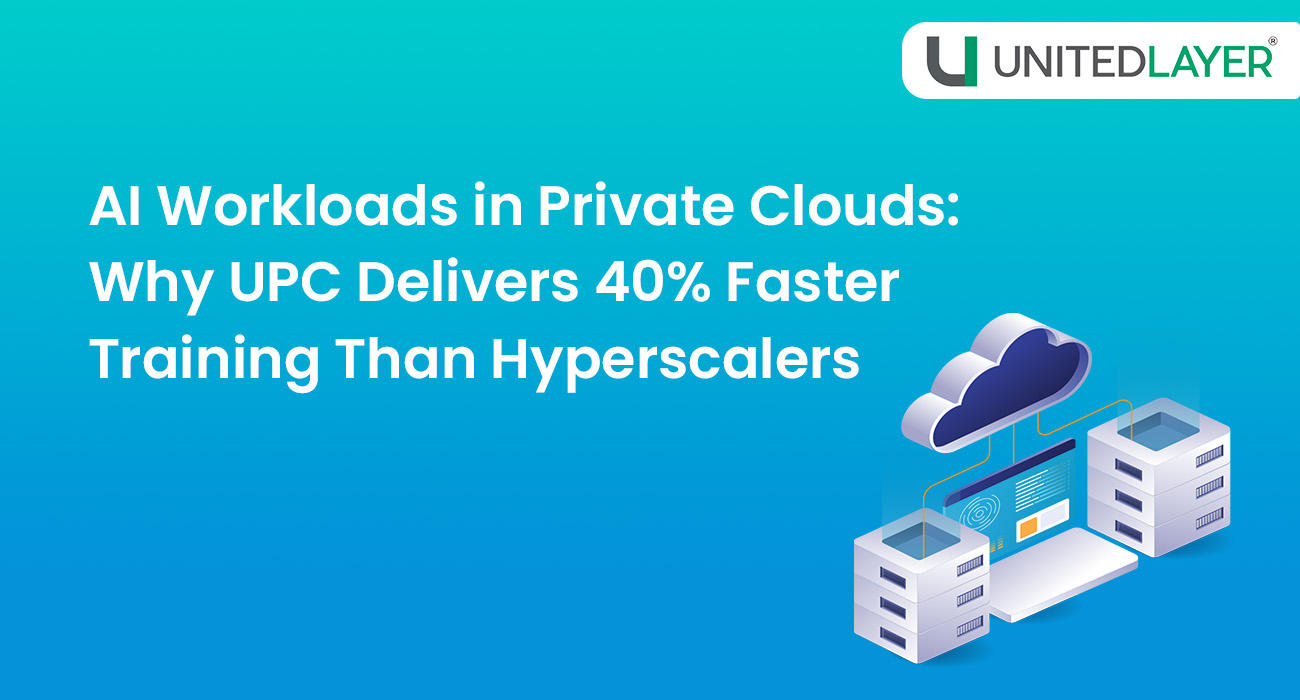
However, a structural bottleneck has emerged as AI models grow to trillions of parameters. Traditional public cloud models often struggle to keep up. Public clouds offer general-purpose scalability. Yet, they were never truly optimized for the “brute force” demands of large-scale AI training. UnitedLayer designed United Private Cloud (UPC) to fix this. It provides a dedicated, single-tenant environment built from the silicon up for high-performance compute. This allows your enterprise to achieve 40% faster training speeds while keeping data secure.
The core issue lies in the noise of multi-tenant environments. In a public cloud, you share infrastructure with thousands of other users. Your mission-critical GPU clusters must compete for bandwidth and memory with unrelated workloads. This competition creates “latency jitter.” Consequently, training cycles can stretch from hours into days.
Public clouds often force you into a “shared-resource roulette.” In 2026, data science teams face three primary roadblocks. Performance inconsistency is now the norm. In a shared cloud, a “noisy neighbor” can throttle your network throughput at any moment. This sudden spike in a stranger’s demand dictates your training speed.
Provisioning volatility has also become a massive risk. The global demand for high-end GPUs often outstrips supply. As a result, enterprises wait in long queues for days. This delay stalls innovation and misses critical market windows.
Finally, the financial model of public clouds is increasingly opaque. Opaque egress fees and high costs for “reserved” instances drive up budgets. These instances often still suffer from shared-resource slowdowns. In many cases, the total cost of ownership is double what teams originally projected.
United Private Cloud flips the traditional script. It offers a fully isolated, single-tenant environment. When you deploy AI workloads on UPC, every component is yours. Every high-end GPU and NVMe storage array is reserved exclusively for your organization. This isolation drives the 40% speed advantage. Without other tenants competing for the backplane, your GPUs reach their theoretical maximum efficiency.
A key technical differentiator is UPC’s use of Remote Direct Memory Access (RDMA). Standard public clouds move data between GPUs through the CPU. This process adds multiple layers of the networking stack and introduces significant latency. UPC’s RDMA-native architecture changes this. It allows GPUs to talk directly to each other’s memory over a 400G software-defined network.
This “zero-copy” networking reduces latency to a fraction of a microsecond. In practical terms, this means your models finish training significantly faster. You no longer waste time on overhead or bottlenecks. By bypassing the CPU, your hardware focuses entirely on processing your data. This architecture ensures your high-stakes projects stay on schedule.
In the world of AI, downtime is an expensive failure. It is more than just an inconvenience. Imagine a hardware component fails 40 hours into a 50-hour training run. You might have to restart the entire epoch. This results in thousands of dollars in wasted compute time. To prevent this, UPC uses a robust N+M redundancy architecture.
Standard clouds often use an N+1 approach. This only provides one backup for a set of active components. In contrast, the N+M model offers multiple layers of concurrent maintainability. This framework ensures a guaranteed 99.999% high availability. If a power supply or networking switch fails, the system fails over automatically. It uses a standby unit without interrupting the compute cycle. This “unbreakable” infrastructure is essential for the long-running workloads of 2026.
Global regulations like GDPR and FedRAMP continue to evolve. Because of this, “Sovereign AI” is now a top corporate priority. Your model weights and proprietary datasets are your most sensitive intellectual property. You can no longer afford to host them in a “black box” where data residency is unclear.
UPC provides a “white-box” alternative for total data sovereignty. Since the infrastructure is single-tenant, you have absolute control. You decide where your data resides and who can access it. Built-in geo-fencing allows you to lock workloads to specific regions. This meets the strict requirements of finance, healthcare, and government projects. Security is a fundamental part of our architecture, not just an add-on.
A move to a private cloud is a move toward operational predictability. In a public cloud, performance varies from day to day. This volatility makes it impossible to forecast project timelines. UPC removes this doubt. We tailor the hardware to your specific machine learning pipelines. We optimize every component for maximum throughput.
Whether you fine-tune a Large Language Model (LLM) or build a computer vision system, UPC adapts. The infrastructure meets your specific workload requirements. This level of customization allows you to scale effortlessly. You can move from a small pilot to a massive deployment without a “re-architecting” tax. Public clouds often charge high fees for these shifts; UPC eliminates them.
Moving to a private cloud does not mean losing agility. UPC features native Kubernetes orchestration. Your team can use the same containerized tools and CI/CD pipelines they already know. We manage the complexity of the hardware through proactive, AI-driven monitoring. This lets your data scientists focus on the science rather than the infrastructure.
As we look toward the future of AI in 2026, the gap will widen. “Standard” compute will no longer satisfy “AI-optimized” needs. United Private Cloud provides the dedicated power and sub-microsecond latency you need to win. It is the foundation for your most ambitious goals.
Connect with us to understand how a GPU-native, single-tenant private cloud can transform your AI performance.




Parna Banerjee